Imported from TikTok
Sri Lankan Egg Hoppers
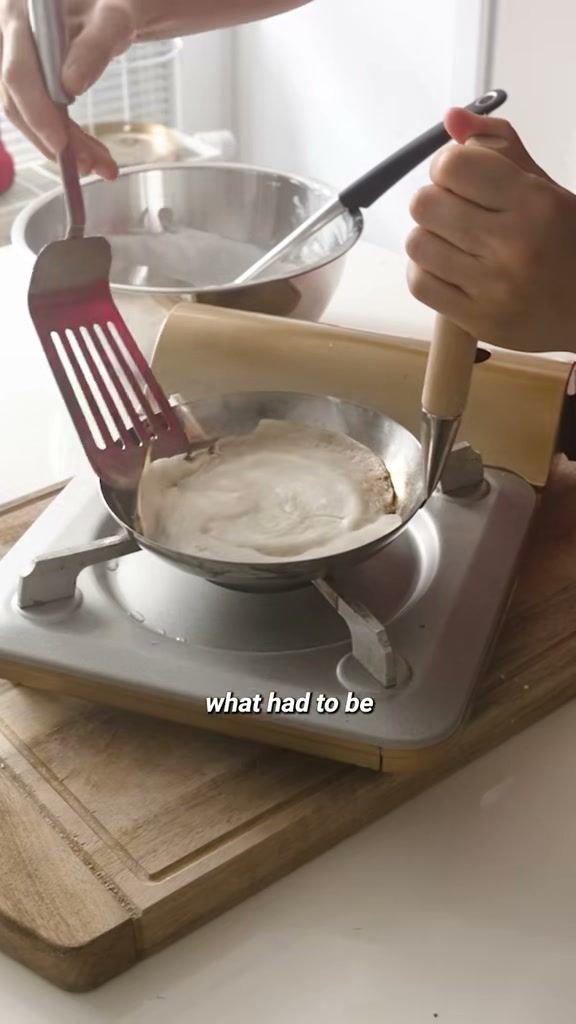
Sri Lankan egg hoppers, also known as appam or apum, are fermented rice-flour pancakes made with coconut milk. They should have a soft, chewy center, crisp lacy edges, and an egg cooked in the middle. The source notes that the batter failed to prove and that a square nonstick pan was used as a workaround.
Cook this recipe, hands-free
Open it in SeeMeCook for step-by-step Cook Mode, built-in timers, and your whole recipe library — free to start.
Ingredients
- 2 cup Rice flour (Used as the base of the fermented batter; quantity estimated because none was stated in the source.)
- 1 cup Coconut milk (Creamy coconut milk; quantity estimated from the dish description.)
- 1 cup Water (Estimated amount for thinning the batter to a pourable consistency.)
- 1 tsp Active dry yeast (Estimated leavening for fermentation; the source only states that the batter was fermented and did not prove.)
- 1 tsp Sugar (Estimated food for the yeast and slight seasoning.)
- Salt (To taste; estimated amount is not specified in the source.)
- 4 Eggs (One egg per hopper; count inferred from an estimated four-serving batch.)
- 2 tbsp Neutral cooking oil (For greasing the pan; amount estimated.)
Steps
- 1
Combine the rice flour, coconut milk, water, yeast, sugar, and salt in a bowl. Whisk until smooth and fully hydrated, with a thin, pourable consistency similar to crêpe batter.
- 2
Cover the batter and leave it in a warm place to ferment until visibly risen and lightly aerated, typically 8–12 hours. The source specifically reports that its batter did not prove, so do not proceed until checking for at least some bubbles or expansion.
- 3
If the fermented batter is too thick, stir in a small amount of water until it can flow easily across the pan. Stir gently so that any bubbles are not completely lost.
- 4
Heat a hopper pan or small nonstick skillet over medium heat. Lightly grease it with neutral oil. A conventional hopper pan is traditional, but the source used a square nonstick pan when the batter stuck.
- 5
Pour a small ladleful of batter into the center of the hot pan. Immediately lift and tilt or swirl the pan so the batter coats the bottom and climbs partway up the sides, leaving the center slightly thicker than the edges.
- 6
Crack one egg into the center of the batter. Cover the pan and cook for several minutes, until the egg white is set, the center remains tender, and the edges are browned and crisp.
- 7
Loosen the hopper carefully with a thin spatula and transfer it to a plate. Repeat with the remaining batter and eggs, lightly greasing the pan between batches as needed.
- 8
Serve the egg hoppers hot, while the edges are crisp and the centers are soft.
Notes
The transcript does not provide a complete ingredient list, quantities, fermentation method, or exact cooking times. This recipe is therefore a reconstruction from the dish description and standard egg-hopper technique, not a faithful measurement-level extraction. Traditional egg hoppers are usually made in a rounded hopper pan; a small nonstick skillet can be used instead. If the batter does not ferment, the texture and release may be poor, as demonstrated in the source.
Nutrition per serving
Every recipe, finally cookable.
Turn your next favorite video into a recipe you can actually follow — ingredients, steps, and times in seconds.
Already have SeeMeCook? Open this recipe →